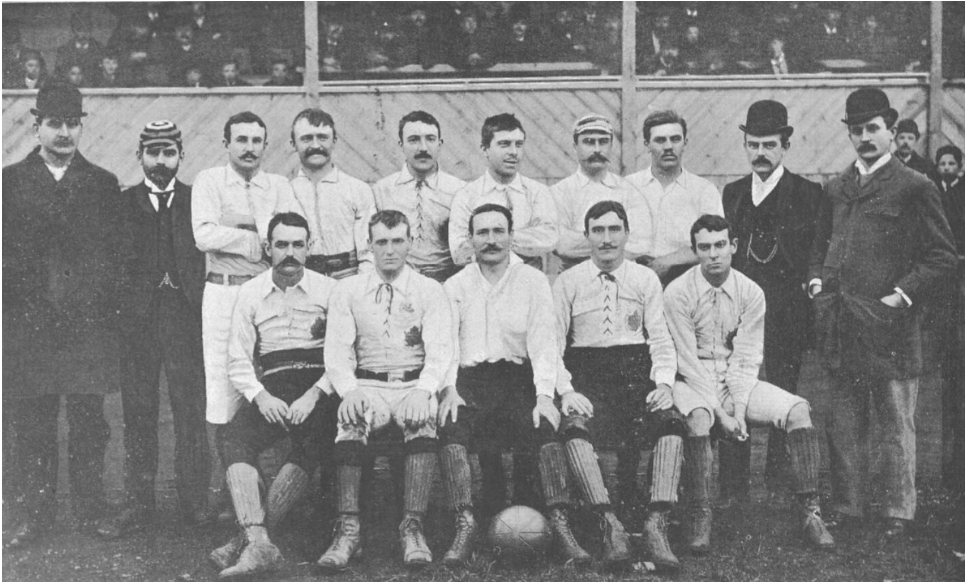
Standing, left to right: J.J. Dalton (Pawtucket), Squires (English referee), H. Waring (Fall River Rovers), F.H. Thibode (Berlin Rangers), W.W. Bowman (Toronto Scotts), F.J. Gregory (Pawtucket), J.W. Buckley (Fall River Rovers), C. Forester (Toronto University), J.E. Ellis (Secretary, Ottawa), W.M. Hill (Ottawa). Sitting, left to right: R. Bell (Fall River Rovers), A. Jeffrey (Pawtucket), W.P. Thomson (Toronto University), D.H. Shea (Fall River Rovers), W.E. Buckingham (Toronto University).
January 8, 1892
The members, under the charge of Mr. Ellis, and after a sojourn of five months, sailed on Friday evening from the Kingston Dock, Glasgow, on board the good ship State of Nebraska, bound for the Dominion. As the departure was made known to a number of football lovers, there was a cosy coterie to see the American-Canadians leave the Clyde, and as the vessel steamed down the river hearty cheers were raised, and kindly good-byes were registered. Our Glasgow correspondent was among the first to meet the Canadians on their arrivals in Glasgow on August 20, and he also chatted with several members of the team, and received from them their impressions of this country, its clubs and its players, ere they left.
The general consensus of the conversations is that the visitors had an idea they would not have it all their own way when they were privileged to practice at Hampden Park, Glasgow, immediately on their arrival in this country, but their first defeat by the Third Lanark R.V. shook them somewhat. Many clubs and officials had treated them kindly, hospitably, and well, and although on one or two occasions they were “riled” at newspaper comments, they as a whole consider they have been received with open arms, and will remember with feelings of affection the welcomes afforded them. Such a reception and send off, as they had in Ireland, when they played the Linfield Athletic F.C., was of the grandest possible description, and of Scotland, and its players they spoke in terms of the highest praise.
The palm they awarded to the Queen’s Park, Glasgow, as the finest combination, and the purest from an amateur point of view they had seen. Several English clubs were mentioned as having good teams, but they seemed to agree that the Wolverhampton Wanderers excelled all others in perfect play individually, and in combination.
Speaking critically of Scottish players, John Alexander Lambie and Walter Arnott were specially singled out as possessing heads and feet worthy of the finest feats in the football field, William Gulliland also coming in for a word of praise, as well as Donald Sillars and William Sellar, while George Gillespie’s goalkeeping received due and friendly reference.
The experience of the game in all its many styles and details gained by this rather lengthened tour would stand the players in good stead, and the result would probably be that in a sense they would seem like football missionaries when they got to the other side of the herring pond.
At all events the visit would be a gain to football in Canada, and in this, as in many other affairs of life, the Dominion would be indebted to the Old Country. Mutual good wishes, firm shakes of the hands, bon voyage. God speed, and good-byes were re-echoed as the young athletes sped on their homeward journey.
(Source: Sporting Life: January 11, 1892)
 American Soccer History
Leave a comment